
If you've been told your migraines are chronic — that you just have to live with it, manage it, medicate it — there's one structural question no neurologist is trained to answer. We answer it with a 3D scan and a 60-minute assessment. Complimentary.
The brainstem sits inside C1. If C1 is off, the signal is off.
The top two vertebrae of your spine — C1 (atlas) and C2 (axis) — form a ring around your brainstem. Every signal going into or out of your brain passes through this junction.
A misalignment of even one millimeter here can irritate the trigeminal nerve system, restrict blood flow, disrupt vestibular signaling, and create the exact pattern of symptoms most migraine patients have been told is "just how your brain is wired."
It's not how your brain is wired. It's a structural interference point. And it's measurable.
Your MRI was clean because your MRI wasn't looking here.
If your pattern matches any of these, you're a candidate for a 3D scan. The scan will tell us whether C1/C2 is part of your problem — or rule it out.
Episodic or daily. With or without aura. If triptans or CGRP inhibitors only work partially — or stop working — upper cervical involvement is worth checking.
Daily, band-like pressure across the forehead or back of skull. Often blamed on "stress." The C1/C2 junction is the most common structural driver.
Pain that starts at the base of the skull and radiates up. By definition, cervical in origin. Upper cervical care is first-line for this type.
After a car accident, fall, sports hit, or whiplash event. If your headaches started after an impact, there's a very high chance of C1/C2 involvement.
Severe, one-sided, episodic — often behind one eye. Neurologically distinct, but the trigeminal nerve pathway connects directly to the upper cervical region.
Rebound headaches from daily triptans, ibuprofen, or opioid painkillers. A different kind of trap — and one upper cervical work can help break.
We go through your full picture — every provider, every medication, every trigger theory, every MRI result. No clipboard fatigue.
A full postural and neurological assessment. We screen for the specific structural markers that suggest C1/C2 involvement in your headache pattern.
If upper cervical care is a fit, we'll walk you through what it would look like. If it's not, we'll point you toward who is. Either way you leave with a plan.
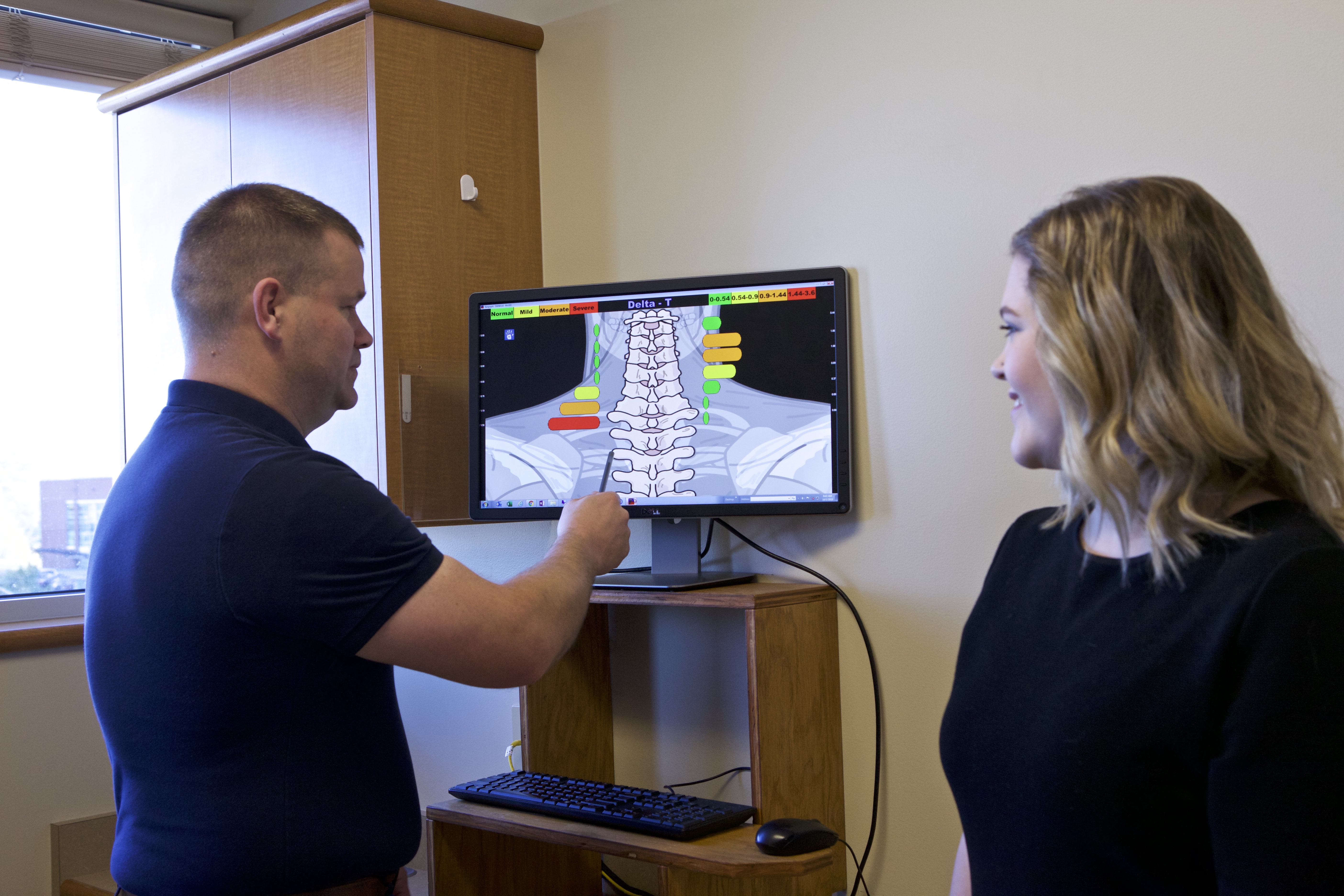 Exam Room · Puyallup
"I was among those that were skeptical of seeing a chiropractor, but here I am almost 4 years later and he's the first one I want to see when I get any type of pain in my body. Never realized it all has to do with alignment and adjustment. No pain meds, and if I really need something, OTC Tylenol does just fine. My migraines are very far and few between."
— Jana · Chronic migraines → far & few between, off prescription pain meds
Yes. Upper cervical corrections don't interact with medication. Most patients start care while still on their current prescriptions — triptans, beta-blockers, CGRP inhibitors, Botox — and taper off with their prescribing doctor as symptoms resolve. We never ask you to stop medication on our recommendation.
Neurologists diagnose and manage migraines — usually pharmacologically. We don't diagnose migraines and we're not trying to replace your neurologist. We measure upper cervical misalignment with 3D CBCT imaging and correct it when it's there. They manage the symptom. We address one possible root cause. Many patients do both.
Most migraine patients report a noticeable change within 2 to 6 corrections. We use objective indicators at every visit — not just how you feel — to measure whether the correction is holding. If there's no measurable change in the first 30 days, we tell you and refer you out. You are not locked into a 6-month plan.
A standard MRI wasn't looking at C1/C2 alignment — it was looking at tissue pathology. CBCT 3D imaging measures structural alignment, which is a different question than whether there's a tumor, lesion, or disc issue. A clean MRI doesn't rule out upper cervical involvement.
Cluster headaches are neurologically different from migraines, but they share a connection to the upper cervical spine and the trigeminal nerve system. Some cluster patients respond very well. The only way to know is to measure. If your scan is clear and your exam doesn't suggest upper cervical involvement, we'll tell you honestly.
No. Botox blocks the muscle signals that amplify migraine pain — it's a symptom-dampening tool. Upper cervical work is a structural tool — we're looking at whether C1 or C2 is interfering with brainstem signaling. Patients often use both. They're not competing treatments.
No. The Blair Technique is a light-force, non-rotational correction. It is one of the gentlest methods in chiropractic. You will not hear a "crack." You will not feel a twist. The correction is precise and quiet.
A complimentary migraine assessment. No pressure. Safe alongside your current meds. Real answers — even if we're not the right fit.
Book Your Migraine Assessment — Free →Or call (253) 256-4818